
How to List Every Country You've Visited on a Visa Application
Visa forms ask for every country visited in the last 5 or 10 years with entry and exit dates. Here's how to rebuild that list accurately and what to do about gaps.
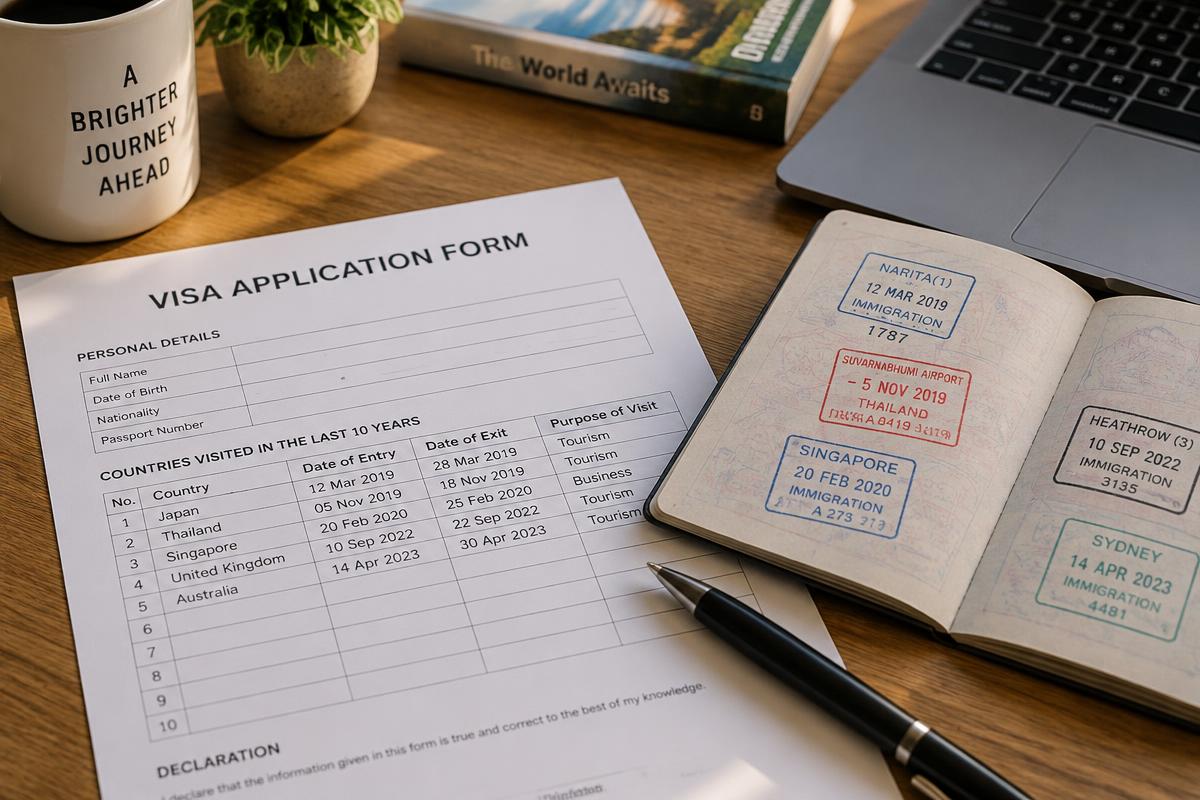
Almost every serious visa, residency and citizenship form eventually reaches the same question: list every country you have visited in the last five or ten years, with the dates you entered and left. It looks like a formality until you try to fill it in, and realise you cannot remember whether that Lisbon weekend was March or April, or which year you went to Bangkok twice.
The short version: read the exact wording on your form to set the date range, gather evidence from passport stamps, airline emails, loyalty and card statements, photo dates and official border records, build one date-ordered table with entry and exit dates, resolve gaps honestly, and keep supporting documents attached to each trip. This guide walks through each step, form by form.
Step 1: Read the question exactly as written
The scope of the answer changes completely depending on the form, so start with the wording rather than with your passport.
The US DS-160 asks which countries you have visited in the last five years, without demanding day-level dates for each one — but consular officers will ask about them at interview. UK settlement and naturalisation applications ask for every absence from the UK during your qualifying period, with exact departure and return dates, because the day counts decide eligibility. Canadian permanent residence and citizenship forms ask for trips outside your country of residence over roughly the last ten years. Schengen short-stay visa forms focus on recent travel and any previous Schengen visas, and the 90/180 balance behind them. Australian and New Zealand forms typically ask about the last ten years plus any visa refusals.
Two things follow. First, the date range you need is set by the form, not by your travel life. Second, some forms want countries while others want absences from one country — those are different lists, and mixing them up is the most common mistake people make.
Step 2: Gather the evidence, in order of reliability
Your travel history already exists; it is simply scattered. Work through these sources in order, because the early ones are the hardest to argue with.
Passport stamps. Photograph every stamped page in good light and transcribe each one: country, date, entry or exit. Remember that whole categories of travel leave no stamp at all — movement inside the Schengen Area, common travel areas, and most automated e-gates.
Airline and booking emails. Search your inbox for "booking confirmation", "e-ticket", "itinerary", "boarding pass" and "check-in". This is usually the richest single source because each email carries the airline, route and date together. Check old work and university addresses too.
Loyalty statements. Frequent-flyer accounts list flown segments going back years, and hotel programmes list stay dates. These show what you actually flew rather than what you booked and later changed.
Card and bank statements. When a flight appears nowhere else, the payment usually does. Statements also help pin down the real arrival day when a stamp is smudged.
Phone location history and photos. If location history was on, your phone knows which city you woke up in on a given date. Photo timestamps do a similar job and often surface a trip you had completely forgotten.
Official border records. Some countries release your own crossing records: the United States publishes I-94 arrival and departure history online, Australia and several other countries provide movement records on request, and the EU's Entry/Exit System is progressively digitising non-EU crossings. These take time to obtain but carry far more weight than anything you assemble yourself.
Step 3: Build one table, in the format the form expects
Consolidate everything into a single table rather than leaving it spread across sources. For each trip record the country, the city you entered through, the entry date, the exit date, the purpose of the visit, and the flight or crossing that took you there. Sort strictly oldest to newest — that is the order nearly every official form uses, and it makes gaps and impossible overlaps visible immediately.
Write dates in the format the form specifies, usually DD/MM/YYYY or MM/DD/YYYY, and keep it consistent throughout. A table where the format drifts halfway down invites a case officer to check everything twice.
Count both the arrival day and the departure day as days present unless the form says otherwise. That convention is what Schengen, most residency day counts, and most tax residency rules use, and applying a different one quietly is how totals stop matching the stamps.
Step 4: Handle gaps honestly
You will hit trips you cannot date precisely. The rule is simple: never invent precision. Use the most conservative date your evidence actually supports, note internally that it is approximate, and keep the supporting document attached to that row. Where a form allows a comment field, say plainly that the date is your best reconstruction.
Watch for the three gaps that cause the most trouble: an entry with no matching exit, two trips that overlap in time, and a stay that runs longer than the visa or waiver allowed. Fix all three before you submit. If a stay genuinely did run over, address it in the application rather than hoping it goes unnoticed — authorities cross-check against airline passenger data and shared border systems.
Step 5: Attach the proof to each trip
Your list is a summary, not evidence. Behind each row you want the artefact that proves it: the stamp photo, the boarding pass PDF, the hotel confirmation, the visa page. If an officer questions one trip out of forty, you want to produce that single document in seconds rather than searching an inbox under time pressure.
Keep everything in one place, named consistently by date and country, so the folder reads in the same order as your table.
Special case: Europe and the 90/180 rule
If your list includes Schengen countries, the dates are doing double duty. Short-stay visitors may spend at most 90 days inside the Schengen Area in any rolling 180-day period, shared across all member countries, with both the arrival and departure day counted in full. Because internal borders are rarely stamped, people routinely undercount. Run your European trips through a 90/180 calculator before you submit anything, so the total you declare matches the total a border officer would compute.
Keep it current so you never rebuild it again
Reconstructing a decade is painful once. Keeping the record current takes about two minutes per trip: log the destination, entry date, expected exit date and purpose when you book, attach the flight details from the confirmation email, then confirm the actual exit date when you get home. Scanning a boarding pass or itinerary PDF reads the airline, flight number, route and dates for you, so most of it is not even typing.
The next time a form asks for ten years of travel, you will be exporting a record instead of excavating one. TripoWay keeps that record privately — every trip in date order, with entry and exit dates, flights, notes and a clean PDF or spreadsheet export you can bring to an application. Start by adding the last trip you took; the rest fills in faster than you would expect.
Frequently asked questions
- How many years of travel history do visa applications ask for?
- It varies by form. The US DS-160 asks which countries you have visited in the last five years. UK settlement and citizenship forms ask for every absence during your qualifying residence period, usually five years, with exact dates. Canadian permanent residence forms ask for trips outside your country of residence over the last ten years. Schengen visa forms focus on recent travel and any previous Schengen stays. Always read the exact wording on your form rather than assuming.
- What if I can't remember the exact dates of a trip?
- Do not invent a precise date. Reconstruct it from a boarding pass, booking email, card statement, loyalty statement, photo timestamp or your phone's location history. If your evidence only supports a range, give the most conservative date you can defend and note that it is approximate where the form allows. An honest approximation is treated very differently from an inconsistency a case officer finds later.
- Do transits and layovers count as countries visited?
- Usually only if you passed through immigration and entered the country. A same-terminal airside layover normally does not count, while clearing passport control on a long layover does. Some forms ask specifically about transits, so read the question. When you are unsure, listing the transit with a short note is safer than omitting it.
- What happens if I leave a country off my travel history?
- Immigration authorities cross-check your answers against stamps, airline passenger data and shared border records. A missing country that turns up in their data looks like a misrepresentation rather than a memory lapse, and it can cost you the application and future ones. Completeness matters more than a tidy-looking list.
- Does a personal travel log count as proof of travel history?
- No. Your own list or app export is an organised summary, not official evidence. What it does is let you fill in the form accurately and quickly, spot gaps before an officer does, and point straight to the underlying proof — stamps, boarding passes, visas — for any trip that gets questioned.
Check your Schengen days
Plug in your recent Europe trips and see exactly where you stand against the 90/180 rule.
See the sample for yourself
Download the free TripoWay sample travel report and preview the format before building your own history.
Keep reading
- Do You Need Travel History for a Visa Application?
Which visa applications ask for your travel history, how many years you need to declare, and how to compile exact entry and exit dates without guessing.
- Visa Prep Made Easy with a Travel Itinerary Scanner
See how a boarding pass scanner builds your complete travel itinerary automatically, so visa prep takes minutes instead of weeks of digging through old emails.
- What Is the TripoWay Sample Travel Report?
Download a free sample travel report and see how a self-reported trip log can support your visa, residency, or citizenship application.